
If you’ve stood in front of the mirror, pressed on your chest, and wondered whether it’s “man boobs” or just some stubborn fat that a few months at the gym should fix — you’re asking the right question. It’s the most common thing men want to know before they do anything else, and the honest answer decides everything that comes next.
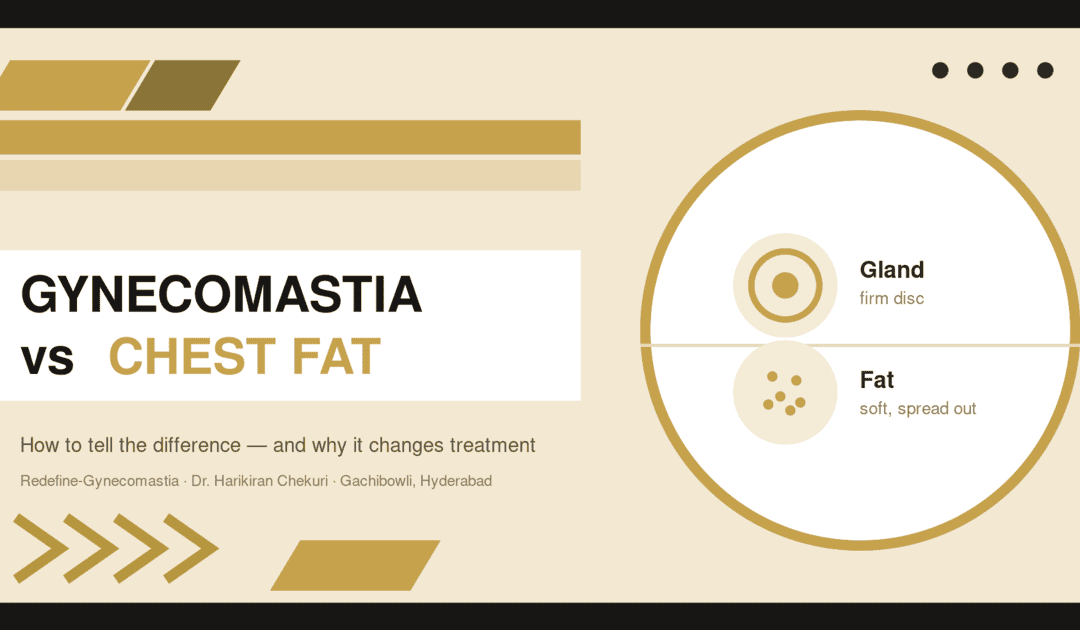
The short version: gynecomastia is enlarged glandular (breast) tissue — a firm, rubbery disc you can usually feel right under the nipple. Chest fat (sometimes called pseudogynecomastia) is soft, spread-out fatty tissue with no firm disc underneath. Why it matters so much: chest fat responds to weight loss, diet and exercise — but true glandular tissue does not shrink no matter how hard you train. That’s why so many men lose weight everywhere else and the chest still won’t flatten. Telling the two apart is the first real step, and a lot of it you can check yourself.
The at-home checks that actually help
None of these replace an examination, but they’ll tell you a lot in two minutes.
The pinch test. Lie down, relax, and gently pinch the tissue around your nipple. A firm, rubbery, disc-like lump concentrated beneath the nipple and areola is likely glandular tissue — gynecomastia. If it feels soft and even, like fat elsewhere on your body, that leans towards chest fat.
Where it sits. Glandular tissue tends to be centred under the nipple and areola, often making the area look puffy or cone-shaped. Fat is more spread out across the whole chest and blends into the sides.
Tenderness. Glandular gynecomastia can feel tender or sensitive, especially if it developed recently. Plain fat usually isn’t.
The gym test. If you’ve genuinely lost weight — your waist and face have slimmed down — but the chest hasn’t changed, that’s a strong hint there’s glandular tissue involved, because fat would have gone with the rest.
One honest caveat: plenty of men have both — a fatty chest and a glandular disc underneath. That mixed picture is common and completely normal, and it’s one reason a self-check can only take you so far.
Why the difference changes your treatment
This isn’t just labelling — it’s the whole reason the two get treated differently. If it’s mostly fat, weight loss and training can genuinely improve it, and where surgery is chosen, liposuction alone often does the job. If it’s glandular, the gland won’t respond to diet, exercise or supplements — it’s removed surgically, usually through a small incision at the edge of the areola. If it’s mixed, the usual approach combines the two: liposuction to address the fat, plus excision to remove the firm gland, so the chest is flat and the shape is even. Getting this wrong is what leads to months of frustration — dieting hard for a problem that was never going to respond to dieting.
What a doctor checks that you can’t at home
A consultation adds what a mirror can’t: a physical examination to confirm whether there’s a firm gland and how much, the grade of gynecomastia (Grade 1 to Grade 4, based on size and whether there’s excess skin), and — if there’s any doubt — an ultrasound to distinguish glandular tissue from fat clearly. In a small number of cases, blood tests are done to check whether a hormonal cause is worth investigating. All of that shapes which technique makes sense for you.
When it’s worth seeing a surgeon
There’s no rush to operate on anything, but it’s worth getting it looked at if the chest hasn’t changed despite real weight loss, you can feel a firm lump under the nipple, it’s tender or has grown recently, or it’s simply affecting how comfortable you feel in a t-shirt. A consultation doesn’t commit you to surgery — it just replaces guessing with an actual answer.
The bottom line
If it’s soft and spread out and it moves with your overall weight, it’s most likely chest fat. If there’s a firm, rubbery disc under the nipple that won’t budge no matter what you do, that points to gynecomastia — and no amount of training will remove the gland itself. The good news is that both are treatable; you just need to know which one you’re dealing with first.
If you’d like to understand exactly what you have — fat, gland, or both — and what treatment would actually look like for you, a consultation with Dr. Harikiran Chekuri at Redefine-Gynecomastia, Gachibowli, Hyderabad takes about 30 minutes, in person or by tele-consultation. You can call or WhatsApp +91 89776 96663 to book.
FAQs
How do I know if I have gynecomastia or just chest fat?
Gently pinch the tissue under your nipple. A firm, rubbery disc concentrated beneath the areola points to gynecomastia (glandular tissue), while soft, evenly spread tissue with no firm core is more likely chest fat. If your chest hasn’t changed despite real weight loss, that also suggests glandular tissue. A physical exam confirms it for certain.
Can chest fat turn into gynecomastia?
No — they’re different tissues. Chest fat is fatty tissue; gynecomastia is enlarged glandular (breast) tissue. However, the same person can have both at once, and weight gain can make an existing glandular problem look and feel larger. Only an examination can separate how much of each is present.
Will exercise get rid of gynecomastia?
Exercise and weight loss can reduce chest fat, but they cannot remove glandular tissue — the gland doesn’t respond to diet, training or supplements. This is why many men slim down everywhere else while the chest stays the same. If a firm disc remains after weight loss, it’s usually glandular and is treated surgically.
Does gynecomastia need surgery, or will it go away on its own?
Gynecomastia that appears during puberty can sometimes settle on its own within a couple of years. When it persists into adulthood, the glandular tissue generally stays and does not resolve with diet or medication — surgery is the reliable way to remove it. A consultation helps confirm whether waiting or treating makes sense for you.
Who can I see in Hyderabad to check whether it’s gynecomastia or fat?
At Redefine-Gynecomastia in Gachibowli, Hyderabad, Dr. Harikiran Chekuri examines the chest to confirm whether the tissue is fat, gland, or both, assigns the grade, and explains the options — with no obligation to proceed. In-person and video consultations are available. Call or WhatsApp +91 89776 96663 to book.
Wondering how a surgeon actually tells gynecomastia from chest fat? Read our Quick Answer: How does a doctor tell gynecomastia from chest fat? — including the pinch test and when ultrasound is needed.
Recent Comments