
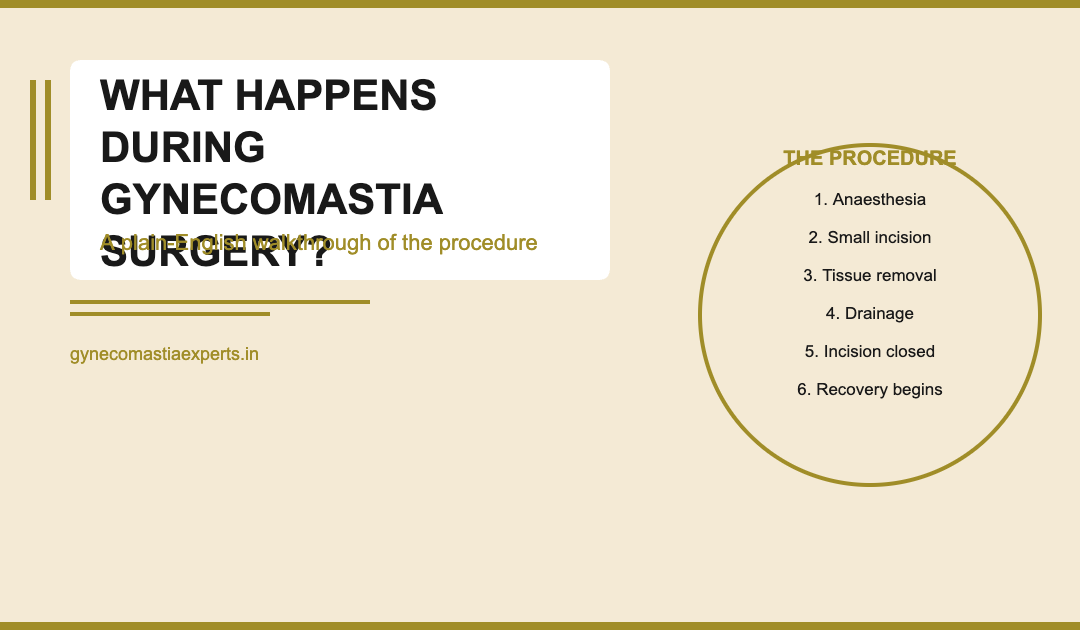
What happens during gynecomastia surgery — from the moment you arrive to the evening you go home — is something most patients cannot find answered clearly online. Medical descriptions of ‘liposuction combined with glandular excision’ tell you the technique, not the experience. This is a plain-English walkthrough from the patient’s perspective.
This is what gynecomastia surgery looks like from the patient’s perspective — from the morning you arrive to the evening you go home.
Before the Procedure Begins
You will arrive at the clinic fasted (typically 6–8 hours, no food or water). At check-in, a pre-operative nurse reviews your vital signs, confirms your medication history, and answers any last questions. You change into a surgical gown and meet the anaesthetist, who explains the anaesthesia plan.
For gynecomastia surgery, general anaesthesia is standard for Grades 2–4 and most Grade 1 cases involving significant glandular tissue. Local anaesthesia with sedation is occasionally used for very minor Grade 1 liposuction-only cases. Dr. Harikiran will have discussed this at your consultation and confirmed the anaesthesia approach for your case.
Surgical marking is done before you enter the theatre — the surgeon marks the areas for liposuction and the planned incision site on your chest while you are standing. These marks guide the procedure under draping.
In the Operating Theatre
Once in theatre, the anaesthetist administers general anaesthesia and you are asleep within seconds. From this point, you are unaware of everything. The surgical team — surgeon, assistant, anaesthetist, scrub nurse — then proceeds with the procedure.
Step 1: Tumescent infiltration. A saline solution mixed with adrenaline and local anaesthetic is injected into the chest tissue. This reduces bleeding, makes fat easier to remove, and provides pain control in the immediate post-operative period.
Step 2: Liposuction. Small (3–4 mm) incisions are made at the lateral chest (towards the armpit). A thin cannula is inserted and moves through the fat tissue in a fanning pattern, breaking it up and suctioning it out. This shapes the chest contour and removes surrounding fatty tissue. For cases that are predominantly fatty (Grade 1), this step alone may achieve the result.
Step 3: Gland excision. A small incision is made at the lower border of the areola — the periareolar incision. The glandular disc is dissected from the surrounding tissue and removed through this incision. This is the step that removes the firm tissue patients can feel as a disc or button under the nipple. The specimen is typically sent for histological review (standard practice, not a sign of concern).
Step 4: Shaping and closure. The surgeon assesses symmetry with both sides done and makes any adjustments to contour. Drains may or may not be placed depending on the case. The incisions are closed with dissolvable sutures. A compression vest is applied before you leave the theatre.
Total operating time: 60–90 minutes for most cases. Grade 3–4 cases with significant skin excess take longer (up to 2–2.5 hours).
Waking Up and Going Home
You wake in the recovery room with the compression vest already on. Some patients notice mild soreness; others feel very little initially due to the local anaesthetic still active. You will be monitored for 1–2 hours post-anaesthesia before being moved to the day-care ward.
Gynecomastia surgery at Redefine-Gynecomastia is a day-care procedure — you go home the same day, typically 3–5 hours after surgery ends. You will need a responsible adult to accompany you and drive you home; you cannot drive yourself. You go home with a prescription for analgesics and antibiotics, written discharge instructions, and the compression vest you are wearing.
The first evening is for rest. Most patients sleep well — the local anaesthetic and post-operative analgesia keep pain manageable. Full recovery information is in our week-by-week recovery guide →
The Incisions and What They Look Like
The incision sites are small by design. The periareolar incision follows the lower border of the areola and, as it heals, blends into the natural skin-colour boundary of the areola. The lateral liposuction incisions (near the armpit) are 3–4 mm and typically heal to barely visible marks.
Scar appearance at 12 months is far better than at 3 months. Scars continue to mature for up to a year and almost always fade significantly.
If you are ready to take the next step, learn about gynecomastia surgery in Hyderabad → or book a consultation →
FAQ
Q: Is gynecomastia surgery done under general anaesthesia?
A: For most cases — Grades 2, 3, and 4, and many Grade 1 cases — yes, general anaesthesia is standard. Very minor Grade 1 cases that require liposuction only may be suitable for local anaesthesia with sedation. Your surgeon will confirm this at consultation.
Q: How long does gynecomastia surgery take?
A: Most cases take 60–90 minutes in the operating theatre. Higher-grade cases with skin excess may take up to 2–2.5 hours. You should plan to be at the clinic for approximately half a day in total.
Q: Can I go home the same day after gynecomastia surgery?
A: Yes. Gynecomastia surgery at Redefine-Gynecomastia is a day-care procedure. Most patients are discharged 3–5 hours after surgery and go home the same evening. You will need a companion to accompany you and drive you home.
Q: Will I be awake during gynecomastia surgery?
A: No. General anaesthesia means you are fully asleep and unaware throughout the procedure. You will not feel or hear anything during surgery.
Recent Comments