
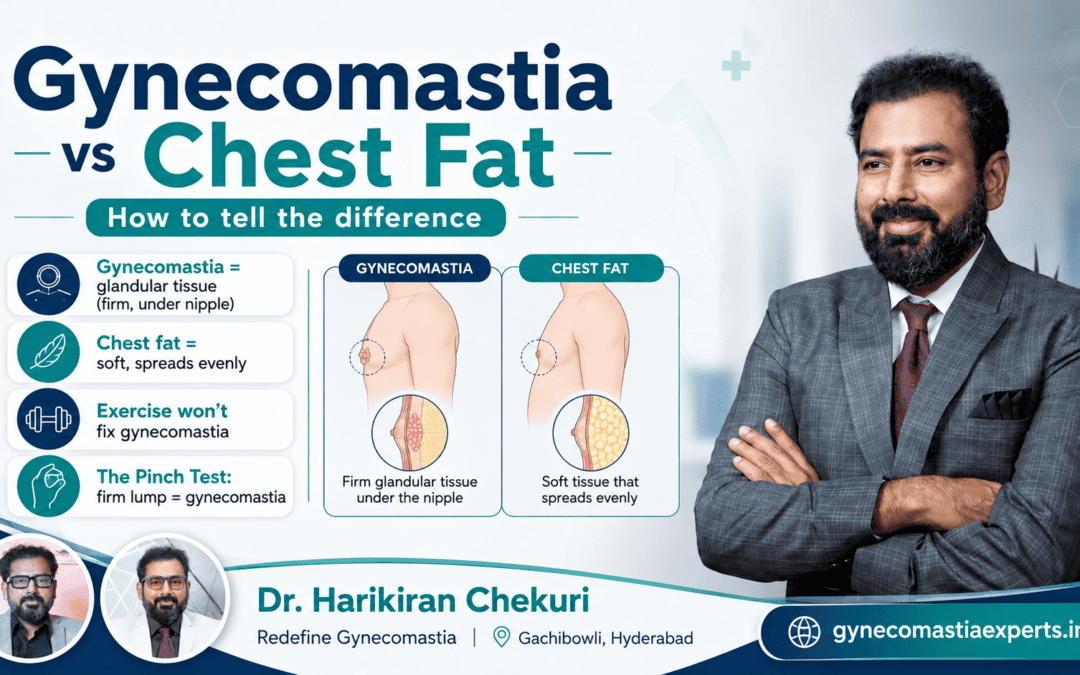
Gynecomastia vs chest fat (pseudogynecomastia) feel similar but have different causes and different solutions. True gynecomastia involves actual glandular breast tissue — firm, located behind the nipple, and unresponsive to diet or exercise. Chest fat is fatty tissue that may reduce with weight loss. The only reliable way to distinguish them is a clinical examination, though there are signs that point in one direction.
Most men who come to us at Redefine in Gachibowli have been carrying the same question for months, sometimes years: is this something I can fix by going to the gym, or is it something that needs surgery? It’s a fair question, and the honest answer depends entirely on which type of tissue is causing the enlargement.
Gynecomastia vs chest fat: what the tissue tells you
The chest wall in gynecomastia is not all the same. Fatty tissue — the kind that increases with weight gain and decreases with fat loss — behaves completely differently from glandular breast tissue, which is firm, often tender, and has no metabolic relationship with your calorie balance. You cannot burn gland tissue. No training programme, no dietary change, no supplement affects it. This distinction matters enormously when deciding on treatment, because the approach for each is different.
Predominantly fatty enlargement, sometimes called pseudogynecomastia, can respond meaningfully to sustained weight loss and resistance training. In men who are significantly overweight, losing 10–15 kg sometimes resolves the appearance substantially. In lean men who have never been overweight, this explanation rarely applies.
True gynecomastia — with a glandular component — requires surgery if the patient wants a definitive resolution. Liposuction for gynecomastia addresses the fatty component; glandular excision removes the dense tissue that liposuction cannot. A significant proportion of patients have both components, which is why the most common procedure is a combination of the two.
Gynecomastia vs chest fat: a quick check you can do at home
There is a simple self-assessment that gives a useful preliminary signal. Press gently inward with two fingers on either side of the nipple, moving toward the centre. In true gynecomastia, most men feel a distinct firm disc — rubbery, sometimes slightly tender — sitting directly beneath the nipple, clearly different from the surrounding soft tissue. With purely fatty enlargement, the consistency tends to be uniform throughout the chest: soft, without a firm centre.
This is a starting point, not a diagnosis. One-sided lumps, hard (rather than rubbery) tissue, nipple discharge, or recent rapid onset at an older age are all reasons to see a doctor promptly, as these can occasionally indicate causes unrelated to gynecomastia that warrant investigation.
Why some men train hard and nothing changes
If you’ve been consistent in the gym for six months or more and the chest fullness hasn’t responded — particularly if the firmness is concentrated directly behind the nipple rather than distributed evenly — it is likely that you have a glandular component. This isn’t a reflection of effort or discipline. It’s simply the nature of the tissue.
The evaluation at Redefine is designed to answer exactly this question. A physical examination takes a few minutes and tells you the composition, the grade, and what would and wouldn’t respond to a non-surgical approach. Many men leave that consultation with clarity they’ve been trying to get from online forums for years.
FAQ
Is chest fat the same as gynecomastia?
No. Chest fat (pseudogynecomastia) is excess fatty tissue with no glandular component. True gynecomastia involves glandular breast tissue behind the nipple. They can coexist, and many men have both. The distinction matters because glandular tissue does not respond to diet or exercise, while fatty tissue may.
Can gynecomastia go away with exercise?
If the enlargement is entirely fatty, sustained exercise and fat loss can reduce the appearance. If there is a glandular component — which can be identified on clinical examination — exercise will not reduce the firm tissue behind the nipple. Surgery is the only effective treatment for glandular gynecomastia.
How do I know if I need surgery for gynecomastia?
A clinical examination is the only reliable way to determine whether your gynecomastia has a glandular component that requires surgery. If you’ve trained consistently without improvement, or you can feel a firm disc behind the nipple, a consultation with a plastic surgeon is a reasonable next step.
Gynecomastia vs chest fat — if you’ve been training without results or feel firmness behind the nipple, a consultation at Redefine in Gachibowli gives you a clear diagnosis. Book now on WhatsApp →
Recent Comments