
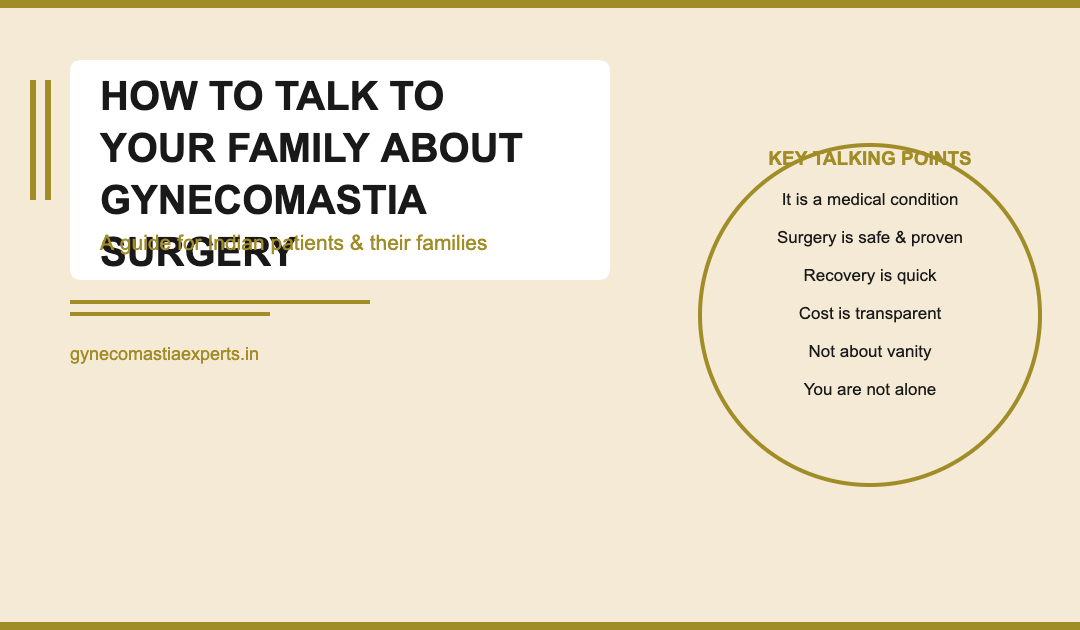
For many men, figuring out how to tell parents about gynecomastia surgery — or how to talk to a partner or sibling — is harder than the surgery itself. One of the most common things patients tell us at their first consultation is that the hardest part was not researching the surgery or finding a surgeon. It was telling their family.
Gynecomastia is a medical condition. It is not a reflection of fitness, effort, or character. But in an Indian household, where conversations about body image, cosmetic procedures, and anything perceived as elective or appearance-related can be charged, many men spend months or years managing the condition in silence before they ever mention it to a parent, partner, or sibling.
If you are in that position, this is for you.
Why the Conversation Feels So Difficult
The stigma around gynecomastia in India is real, and it runs in two directions simultaneously. On one side, there is the embarrassment of the condition itself — many men have been teased about their chest since adolescence and have spent years concealing it. On the other side, there is the perception in many families that cosmetic surgery is “vain,” unnecessary, or something to be ashamed of.
Caught between both, men often say nothing at all. They book consultations privately, research costs without discussing them at home, and sometimes attempt to schedule surgery without their family knowing. This rarely works well — and it means going through recovery without emotional support.
The family conversation does not have to be confrontational. In our experience at Redefine-Gynecomastia, families are almost always more understanding than patients expect, once they understand what gynecomastia actually is.
Start With the Medical Facts, Not the Emotional Ones
The most effective way to open this conversation is to lead with the clinical reality, not your feelings about it. If you begin with “I hate my chest and it’s making me miserable,” the conversation can quickly become about reassurance (“you look fine!”) rather than about the actual problem.
Start instead with: “I have a medical condition called gynecomastia — it is the abnormal growth of glandular breast tissue in men. It does not go away on its own, and surgery is the only way to treat it.”
This framing does two things. It names the condition precisely, removing it from the realm of body image anxiety. And it establishes that you are not talking about wanting to look better — you are talking about treating something medical.
If your family member is unfamiliar with gynecomastia, the most helpful thing you can share is that it is caused by a hormonal imbalance — the same mechanism that causes breast development — and that it is common (estimates suggest it affects 30–60% of men at some point in their lives, though most cases resolve during puberty). You happened to have the type that did not resolve on its own.
Address the “Why Not Just Exercise?” Question
This will come up. “Have you tried the gym? Couldn’t you just lose weight?”
The honest answer — and you can say it this way — is: “Glandular tissue is not fat. Exercise cannot remove it. I have looked into this thoroughly, and surgery is the only treatment that works for the type of gynecomastia I have.”
You do not need to debate this. If the family member wants to understand more, you can show them the gynecomastia vs chest fat guide that explains the distinction clearly.
Talking to a Parent Who Sees Surgery as Unnecessary
Parents who grew up in an era before cosmetic procedures were widely discussed often interpret any surgery as either dangerous or excessive. Their concern is usually about risk, not about judging you.
Address the risk concern directly: gynecomastia surgery is a day-care procedure performed under general anaesthesia, taking about 60–90 minutes. The recovery is 7–10 days to return to desk work. It is not a major operation.
You might also address the “unnecessary” framing: the condition has affected your confidence and daily life for years. That is a real cost — not vanity. Treating it is not different from treating any other condition that affects quality of life.
Talking to a Partner
Partners sometimes feel unseen in this conversation — as if their acceptance of you should be enough, and surgery is an implicit criticism of their love. This is not the case, and it is worth saying so explicitly.
A helpful framing: “This has nothing to do with how you see me or how our relationship makes me feel. This is something I have struggled with since I was young. I want to feel comfortable in my own body — and fixing this is something I am doing for myself.”
Most partners, once they understand the duration and depth of the issue, are supportive. The conversation often opens up a level of honesty about a long-suppressed discomfort that actually strengthens the relationship.
When to Have This Conversation
There is no perfect moment, but timing matters. Avoid starting this conversation when either party is stressed, tired, or rushed. A calm evening at home with time to talk is better than a car ride or a phone call.
You do not need to have the full surgery-planning conversation on day one. Starting with “I want to tell you about something I’ve been dealing with for a long time” is enough. Once the medical reality is understood, the question of treatment follows naturally.
You Are Not Alone in This
At Redefine-Gynecomastia, we see patients at every stage of this journey — some who came in alone and haven’t told anyone, some who brought a parent or partner to the consultation, and some who are scheduling surgery with full family support. All of these are valid starting points.
If you are ready to take the next step, we are here to answer your questions — and if you would like to bring a family member to the consultation to hear the medical facts directly from Dr. Harikiran Chekuri, you are more than welcome to.
Book a consultation → | Learn about the procedure → | See what surgery involves →
FAQ
Q: How do I tell my parents I want gynecomastia surgery?
A: Start with the medical facts — gynecomastia is a diagnosed condition caused by abnormal glandular tissue growth, and surgery is the established treatment. Leading with the clinical reality rather than your emotional experience helps family members understand that this is a medical decision, not a cosmetic one.
Q: Is it normal to feel embarrassed telling your family about gynecomastia?
A: Very common. Most of our patients have lived with gynecomastia for years without discussing it openly. The condition carries a stigma that makes the conversation difficult. What most patients find is that families are more understanding than expected once they know what the condition actually is.
Q: Should I bring a family member to my gynecomastia consultation?
A: If it would help your family understand the condition and the procedure, yes — you are welcome to bring a parent or partner to the consultation. Many patients find it easier to let Dr. Harikiran explain the medical facts directly rather than relaying them second-hand.
Q: What if my family says I don’t need surgery?
A: Their instinct is usually to protect you, not to dismiss what you are experiencing. Share the facts: glandular gynecomastia does not resolve without surgery once it has fibrosed. A medical consultation — and you are welcome to bring them along — often carries more weight than an online search.
Recent Comments