
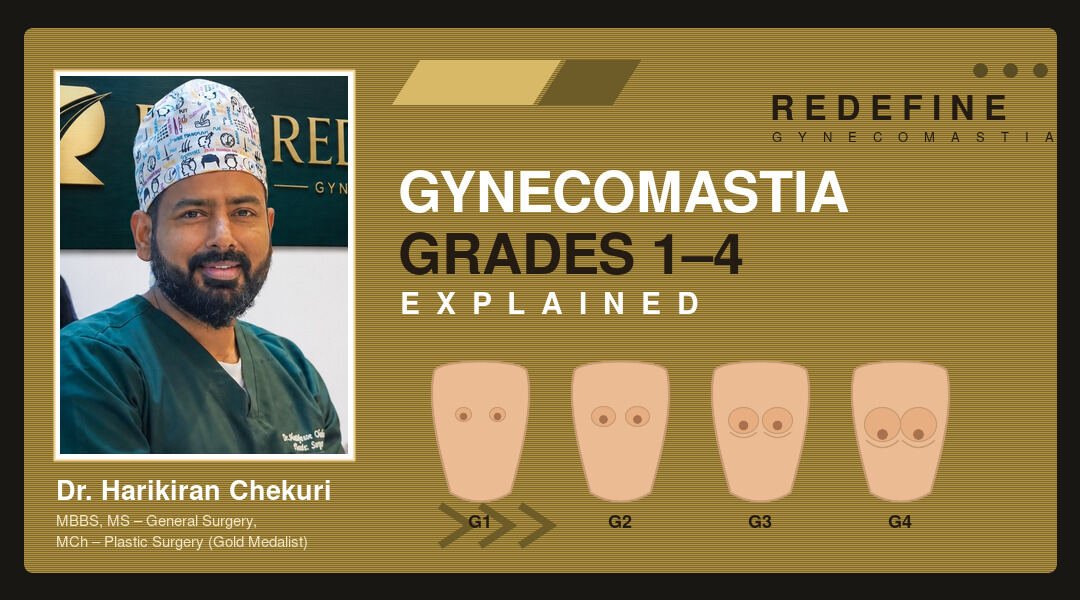
Gynecomastia is classified into four grades — Grade 1 to Grade 4 — based on the amount of glandular tissue, degree of skin laxity, and surgical complexity required. Grade 1 is the mildest: a small, firm disc of tissue under the nipple with no excess skin. Grade 4 is the most severe: substantial breast enlargement with significant skin sagging, similar in appearance to female breast development. Your grade determines which surgical technique is used, how long recovery takes, and what the procedure costs.
When men notice changes in their chest, they usually ask the same thing first: “how bad is mine?” It’s a fair question. After all, gynecomastia is not one condition with one look. In fact, doctors sort it into gynecomastia grades, numbered 1 to 4. So your grade shapes what comes next: the right technique, the recovery, and the price.
Gynecomastia affects an estimated 40–65% of men at some point in life. Yet the severity varies a lot. For example, some men feel only a small, coin-sized firmness under the nipple. Others, by contrast, carry a fuller chest with loose skin. In short, knowing your grade turns guesswork into a clear plan.
Dr. Harikiran Chekuri is a gynecomastia surgeon in Hyderabad at Redefine. He puts it simply. The grade is not a label to fear. Instead, think of it as a map. So once you know the grade, the treatment and cost follow naturally.
First, what does “grade” actually mean?
What Do Gynecomastia Grades Mean?
A grade measures two simple things. First, how much tissue has enlarged. Second, how much loose skin comes with it. In total, the scale runs from Grade 1 (mild) to Grade 4 (severe, with excess skin). This matters because each problem needs a different fix. For instance, liposuction and gland excision remove extra tissue. Loose skin, meanwhile, sometimes needs tightening or trimming.
A physical exam confirms your grade. First, your surgeon checks whether the lump is fat or firm gland. Next, he measures how far it spreads past the areola. Finally, he checks whether the skin has stretched. Only then does he choose a technique.
Let’s walk through each grade.
Grade 1 — Mild
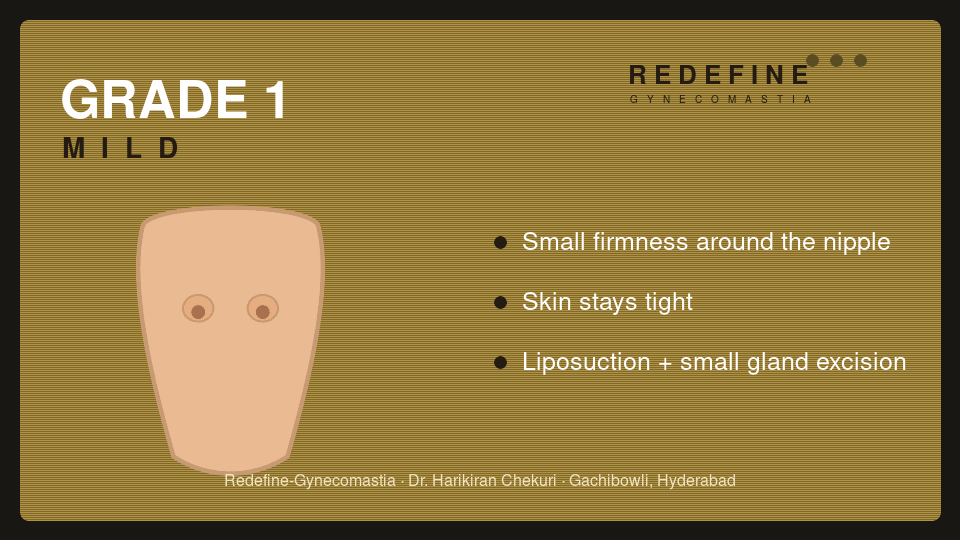
The mildest form is Grade 1. Here you feel a small, firm lump right under the nipple, often the size of a coin. Also, the skin stays tight, and nothing spreads into the wider chest. So from a distance the chest looks normal. In fact, the puffiness shows mainly in a fitted t-shirt.
How we treat it: first, the surgeon removes the small gland through a tiny cut at the edge of the areola. Then a little liposuction handles any minor fat. As a result, it is a quick day-care procedure, and recovery is short.
Grade 2 — Moderate
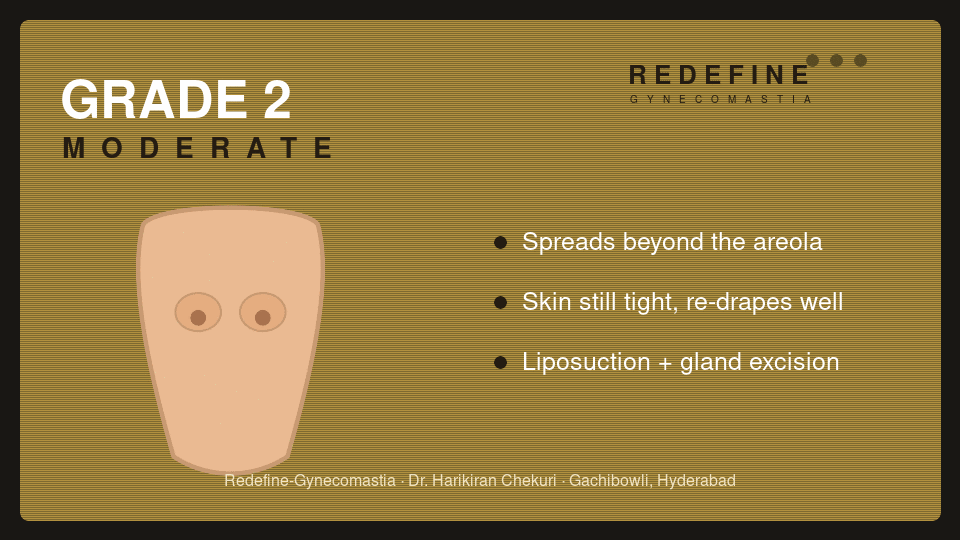
The change becomes clearer at Grade 2. Now the enlargement spreads beyond the areola into the chest. Even so, the skin stays tight and does not sag. In fact, most adult men arrive at this grade. So the chest looks fuller under clothes, yet the skin re-drapes well once the tissue is gone.
How we treat it: first, liposuction clears the fatty part. Then the surgeon excises the firm gland. Together these give a flat, even contour. Skin removal, however, is rarely needed here.
Grade 3 — Significant
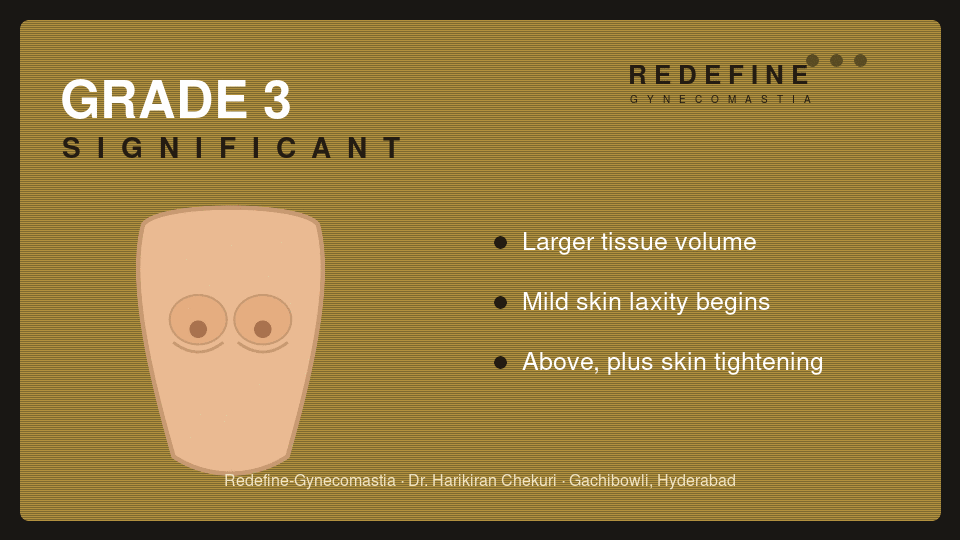
The picture is more advanced at Grade 3. Now the tissue is larger, and the skin has started to lose some stretch. As a result, the skin may not tighten fully on its own. So the chest can look heavier and begin to droop.
How we treat it: here the surgeon combines liposuction and gland excision, often with skin-tightening steps. However, the exact plan depends on how far the skin has stretched.
Grade 4 — Severe
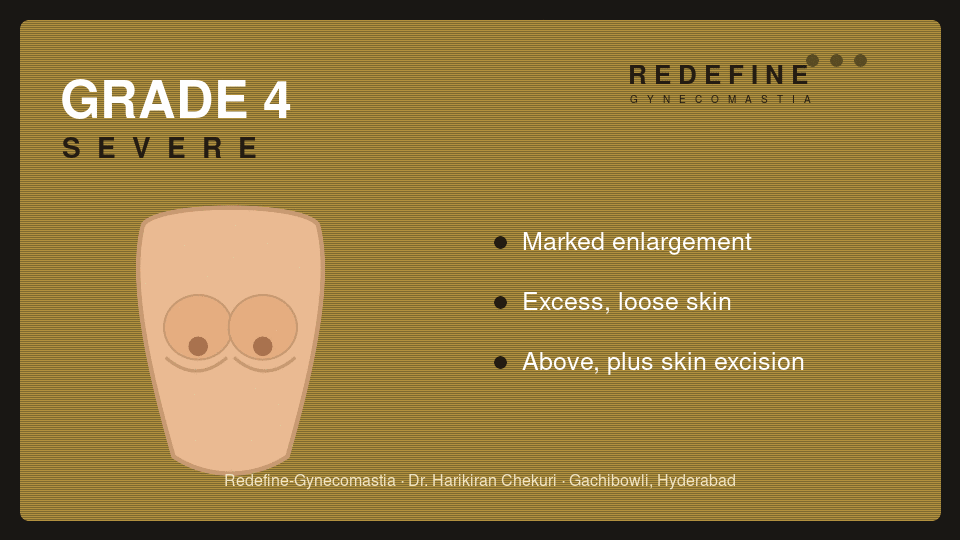
The most advanced stage is Grade 4. Here the chest shows marked enlargement with clear excess skin. In fact, it can resemble a female breast shape, with the nipple sitting lower. Moreover, the skin has stretched too far to shrink back. So removing tissue alone will not work.
How we treat it: first, the surgeon removes the fat and gland. Then he trims the excess skin. Sometimes he also repositions the nipple for a natural look. As a result, this procedure is bigger, and recovery takes a little longer. The visible change, though, is the greatest.
So how does the grade change your treatment?
How Gynecomastia Grades Decide Treatment
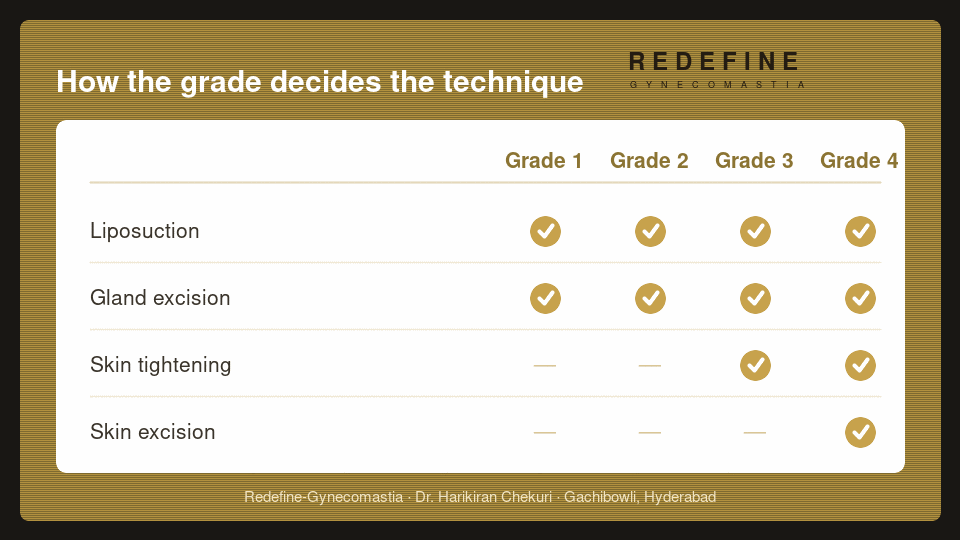
The grade points straight to the technique. In short, here is the logic.
Mostly fat, tight skin (Grade 1–2): usually, liposuction with a small gland excision does the job. As a result, recovery is quick, and scars stay small.
A firm gland is present: diet, exercise and medicine will not shrink a gland. Therefore, the surgeon removes it through a small cut at the areola, at any grade.
Loose or excess skin (Grade 3–4): here the surgeon pairs tissue removal with skin tightening or skin excision. As a result, this keeps the chest from looking deflated.
A mirror can only tell you so much. For example, two men who look alike can sit at different grades once a surgeon examines the skin and gland. So that difference changes the operation.
How Gynecomastia Grades Affect Cost in Hyderabad
Higher grades mean more work, more tissue, and sometimes skin removal. Therefore, the gynecomastia surgery cost in Hyderabad rises with the grade. At Redefine, Gachibowli, the ranges are easy to follow.
Mild (Grade I): liposuction and gland excision — ₹80,000 to ₹1,00,000.
Moderate (Grade II): liposuction and gland excision — ₹90,000 to ₹1,10,000.
Significant (Grade III): liposuction, gland excision, and sometimes skin tightening — ₹1,00,000 to ₹1,30,000.
Severe (Grade IV): liposuction, gland excision, and skin removal — ₹1,30,000 to ₹1,50,000.
0% EMI plans are available. In addition, your surgeon gives an exact estimate at consultation, once he confirms your grade. So treat the figures above as a guide, not a final quote.
Not sure which grade you might be? Here is when to get checked.
When to See a Surgeon

There is no rush to operate on gynecomastia. Still, a few signs make an assessment worthwhile. For example, book a visit if your chest hasn’t changed after real weight loss. Also get checked if you feel a firm lump under the nipple. Similarly, see a surgeon if the area feels tender or has grown lately. Finally, come in if it affects how you feel in a t-shirt. In any case, a consultation confirms your grade and lays out the options, with no pressure to proceed.
At Redefine-Gynecomastia in Gachibowli, Hyderabad, Dr. Harikiran Chekuri (MBBS, MS – General Surgery, MCh – Plastic Surgery) examines your chest. First, he confirms whether it is fat, gland, or both. Then he assigns the grade and explains what treatment involves. Moreover, you can visit in person or consult by video. So call or WhatsApp +91 89776 96663 to book.
FAQs
How do I know what grade of gynecomastia I have?
Only a physical exam can confirm your grade. After all, it depends on how much gland is present and how far the skin has stretched, which a mirror cannot measure. As a rough guide, a small firmness at the nipple is usually Grade 1. However, tissue that spreads past the areola with tight skin points to Grade 2. Meanwhile, visible sagging or loose skin points to Grade 3 or 4.
Does a higher grade mean a bigger operation?
Usually, yes. For instance, Grade 1 and 2 often need only liposuction and a small gland excision. Grade 3 and 4, however, may also need skin tightening or skin removal. As a result, higher grades involve a little more surgery and a slightly longer recovery. Still, they deliver the most noticeable change.
Can gynecomastia get worse and move up a grade?
Yes, it can. For example, weight gain, some medicines, and hormone shifts can add tissue and stretch the skin over time. Moreover, existing gland tissue will not vanish on its own. So a mild case left for years can grow more pronounced.
Grade 4 and cost questions
Is Grade 4 gynecomastia still treatable?
Yes. Grade 4 is the most advanced form, with excess skin as well as enlarged tissue. Therefore, the surgeon treats it by combining liposuction, gland excision, and skin removal. Recovery runs a little longer than lower grades. Even so, the improvement is usually the greatest.
How much does gynecomastia surgery cost for my grade in Hyderabad?
In general, cost rises with the grade. At Redefine-Gynecomastia in Gachibowli, for example, expect roughly ₹80,000–₹1,00,000 for Grade I and ₹90,000–₹1,10,000 for Grade II. Meanwhile, Grade III runs ₹1,00,000–₹1,30,000, and Grade IV runs ₹1,30,000–₹1,50,000. In addition, 0% EMI is available, and your surgeon gives an exact estimate once he confirms your grade.
Reference Links:
https://www.ncbi.nlm.nih.gov/books/NBK430812/
https://my.clevelandclinic.org/health/diseases/16227-enlarged-male-breast-tissue-gynecomastia
Want a direct answer to a specific gynecomastia question? Visit our Gynecomastia Quick Answers — short, medically reviewed responses from Dr. Harikiran Chekuri, including Grade I vs Grade II — which needs surgery? and Does gynecomastia need surgery?
Recent Comments