

Is gynecomastia surgery permanent? For the vast majority of patients, yes — it is a one-time procedure with lasting results. The glandular tissue that causes the condition is physically removed during surgery — it does not regenerate. Once excised, that specific tissue is gone for good.
That said, “permanent” has an important qualifier: the surgery permanently removes the existing gland, but it cannot prevent new glandular tissue from forming if the underlying hormonal trigger reappears or persists. Understanding this distinction is what separates a realistic expectation from a disappointing one.
Why Results Are Permanent in Most Cases
Gynecomastia is caused by the growth of glandular breast tissue — a firm, disc-like structure beneath the nipple that develops when oestrogen levels are elevated relative to testosterone. During surgery, the surgeon removes this gland through a small periareolar incision, combined with liposuction of surrounding fatty tissue.
Glandular tissue, once removed, does not grow back from the excision site. The cells are gone. What patients see at their 3-month review — a flat, contoured chest — is the permanent structural result of the surgery, barring the exceptions below.
At Redefine-Gynecomastia, the vast majority of patients treated by Dr. Harikiran Chekuri maintain their results long-term without requiring revision.
When Can Gynecomastia Come Back?
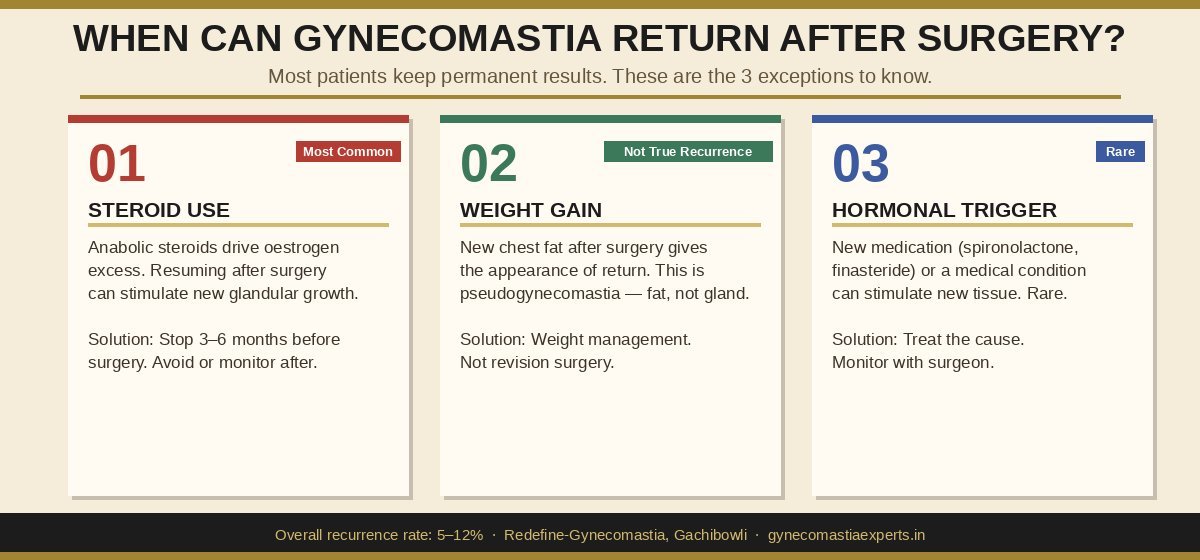
Recurrence is uncommon but not impossible. The three scenarios where it happens:
1. Ongoing or Resumed Steroid Use
This is the most common cause of recurrence in younger men. Anabolic steroids drive oestrogen excess through aromatisation, which stimulates residual breast tissue to grow. If a patient resumes steroid use after surgery — particularly without aromatase inhibitors — new glandular tissue can form over time. The surgery removed the original gland; it cannot prevent a new hormonal stimulus from producing fresh tissue.
The solution is straightforward: stop anabolic steroid use before surgery, stay off for at least 3–6 months pre-operatively, and either avoid them post-operatively or use appropriate medical supervision if returning to performance sport. Read our full guide on steroid-induced gynecomastia →
2. Significant Weight Gain
Surgery removes glandular tissue and much of the surrounding fat. If a patient gains substantial weight post-operatively, new fat deposits can accumulate in the chest area, giving the appearance that the condition has returned. This is not true gynecomastia recurrence — it is pseudogynecomastia (chest fat enlargement). It responds to weight management rather than revision surgery.
3. New Hormonal Triggers
Certain medications — spironolactone, finasteride, some antipsychotics and antihypertensives — can trigger new glandular growth if started after surgery. Liver disease, testicular conditions, and some tumours can also shift the hormonal balance. If a patient develops a new hormonal cause, a small amount of new glandular tissue can theoretically form. This is rare and typically manageable.
What the Research Says
Studies on gynecomastia recurrence report rates of approximately 5–12% at long-term follow-up, with the majority of recurrences linked to resumed steroid use or new medical causes — not the surgical technique itself. In patients without these risk factors, recurrence is uncommon. (Reference: StatPearls — Gynaecomastia, NCBI)
The quality of the surgery matters too. Complete gland excision — leaving no residual disc behind the nipple — reduces the likelihood of apparent recurrence. Incomplete excision leaves a remnant that can respond to hormonal stimulation. This is why surgeon experience and technique are relevant to long-term outcomes, not just immediate aesthetics.
What to Expect at Your Consultation
At Redefine-Gynecomastia, the pre-operative consultation includes a thorough review of any medications, supplement use (including gym supplements and performance drugs), and hormonal history. This is not to judge — it is to ensure the surgical plan accounts for your individual recurrence risk and gives you the best chance of a lasting result.
If you are on anabolic steroids, finasteride, or other implicated medications, Dr. Harikiran will advise on the appropriate washout period before scheduling surgery.
Book a consultation → | Learn about gynecomastia surgery →
FAQ
Can gynecomastia come back after surgery?
In most patients, it does not. The surgical procedure physically removes the glandular tissue, which does not regenerate. Recurrence can occur if a new hormonal trigger appears after surgery — most commonly resumed anabolic steroid use or a new medication that stimulates breast tissue. In patients without these risk factors, long-term results are typically permanent.
Does gynecomastia surgery have a high recurrence rate?
Studies report recurrence rates of roughly 5–12% at long-term follow-up, with the majority linked to external hormonal triggers rather than the surgery itself. In patients without ongoing steroid use or new hormonal causes, recurrence is uncommon.
How long do gynecomastia surgery results last?
For most patients, results are permanent. The chest remains flat indefinitely, provided there are no new hormonal triggers. The 3-month post-operative review is when the final, settled result is assessed — by this point, swelling has resolved and the outcome is stable.
Will I need a second gynecomastia surgery?
Most patients do not. Revision surgery is typically needed only when there has been true recurrence from a hormonal cause, or when the original surgery left residual tissue. A thorough pre-operative assessment and complete gland excision reduce the likelihood of needing revision.
Recent Comments